
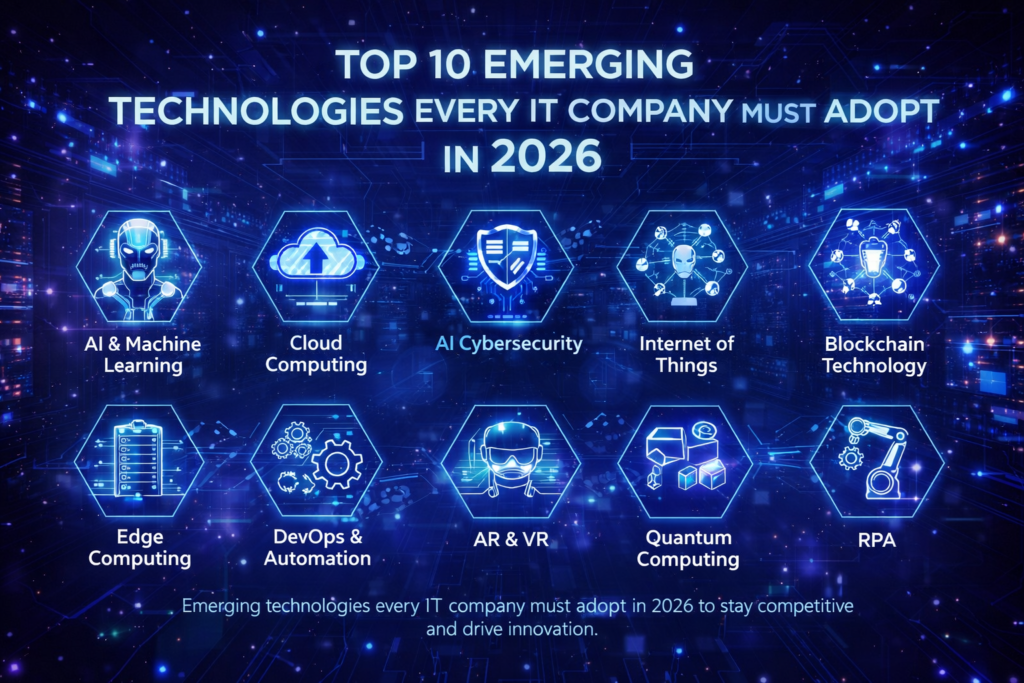
In today’s fast-paced digital era, the IT industry is evolving at an unprecedented rate. Businesses are under constant pressure to innovate, optimize operations, and deliver exceptional user experiences. The rapid advancement of technology is not just reshaping how companies operate—it is redefining entire industries. For IT companies, staying competitive means embracing innovation and adopting emerging technologies that can drive efficiency, scalability, and long-term growth.
As we move into 2026, organizations that fail to adopt new technologies risk falling behind their competitors. From Artificial Intelligence to Quantum Computing, the digital transformation wave is accelerating. These technologies are helping companies automate processes, enhance cybersecurity, improve decision-making, and deliver personalized services. In this article, we explore the top 10 emerging technologies every IT company must adopt in 2026 to remain competitive and future-ready.
1. Artificial Intelligence (AI) and Machine Learning (ML)
Artificial Intelligence (AI) and Machine Learning (ML) are at the forefront of technological innovation. These technologies enable machines to learn from data, identify patterns, and make decisions with minimal human intervention. In 2026, AI is no longer optional—it is a core component of modern IT strategies.
IT companies are using AI for a wide range of applications, including chatbots, recommendation engines, fraud detection, and predictive analytics. Machine learning algorithms can analyze massive datasets to uncover insights that would be impossible for humans to detect manually. This leads to improved decision-making and enhanced operational efficiency.
AI also plays a significant role in automation. Businesses can automate repetitive tasks, reduce human error, and improve productivity. Moreover, AI-driven personalization helps companies deliver tailored experiences to customers, increasing satisfaction and engagement.
2. Cloud Computing and Multi-Cloud Strategies
Cloud computing continues to be the backbone of modern IT infrastructure. It allows businesses to store, manage, and process data over the internet instead of relying on physical servers. In 2026, cloud adoption is more widespread than ever, with companies increasingly shifting to multi-cloud and hybrid cloud environments.
A multi-cloud strategy enables organizations to use multiple cloud service providers, reducing dependency on a single vendor. This improves reliability, flexibility, and cost efficiency. Businesses can choose the best services from different providers and optimize their operations accordingly.
Cloud computing also supports remote work, scalability, and real-time collaboration. IT companies can quickly scale resources up or down based on demand, ensuring optimal performance and cost management. Additionally, cloud platforms integrate seamlessly with other technologies like AI and big data analytics.
3. Cybersecurity with AI Integration
As technology advances, cyber threats are becoming more sophisticated. Cybersecurity is no longer just about protecting data—it is about ensuring business continuity and maintaining customer trust. In 2026, AI-powered cybersecurity solutions are essential for IT companies.
AI enhances cybersecurity by detecting unusual patterns, identifying potential threats, and responding in real time. Machine learning algorithms can analyze network behavior and flag anomalies that may indicate a cyberattack. This proactive approach helps prevent breaches before they occur.
Additionally, AI-driven security systems continuously learn and adapt to new threats, making them more effective than traditional methods. IT companies can use these systems to protect sensitive data, secure networks, and comply with regulatory requirements.
4. Internet of Things (IoT)
The Internet of Things (IoT) is transforming how devices interact and communicate. IoT connects physical devices to the internet, enabling them to collect and exchange data in real time. This technology is widely used in industries such as healthcare, manufacturing, transportation, and smart homes.
In 2026, IoT adoption continues to grow as businesses leverage connected devices to improve efficiency and automation. For example, smart sensors can monitor equipment performance and predict maintenance needs, reducing downtime and costs.
IoT also enables real-time monitoring and control of systems, allowing businesses to make data-driven decisions. However, with increased connectivity comes increased security risks, making it essential for IT companies to implement robust security measures.
5. Blockchain Technology
Blockchain technology provides a secure and transparent way to record transactions. It uses a decentralized ledger system that ensures data integrity and prevents unauthorized changes. While initially popularized by cryptocurrencies, blockchain has expanded into various industries.
In 2026, IT companies are using blockchain for applications such as supply chain management, digital identity verification, and secure data sharing. The transparency and immutability of blockchain make it ideal for building trust in digital transactions.
Blockchain also reduces the need for intermediaries, lowering costs and improving efficiency. As businesses continue to prioritize security and transparency, blockchain adoption is expected to grow significantly.
6. Edge Computing
Edge computing is a distributed computing model that processes data closer to its source rather than relying on centralized data centers. This reduces latency and improves performance, making it ideal for real-time applications.
In 2026, edge computing is essential for technologies like IoT, autonomous vehicles, and smart cities. By processing data locally, businesses can achieve faster response times and reduce bandwidth usage.
Edge computing also enhances data security, as sensitive information can be processed locally instead of being transmitted over networks. IT companies can use edge computing to improve efficiency, reduce costs, and deliver better user experiences.
How Cybersecurity Is Evolving in Modern Enterprises
7. DevOps and Automation Tools
DevOps is a set of practices that combines software development and IT operations to improve collaboration and efficiency. In 2026, DevOps continues to play a crucial role in accelerating software delivery and enhancing product quality.
Automation is a key component of DevOps. Tools like CI/CD pipelines enable continuous integration and continuous deployment, allowing teams to release updates faster and more reliably. Automation reduces manual errors and ensures consistency across development processes.
IT companies adopting DevOps can improve productivity, reduce time-to-market, and enhance customer satisfaction. The integration of AI into DevOps further enhances automation and decision-making capabilities.
8. Augmented Reality (AR) and Virtual Reality (VR)
Augmented Reality (AR) and Virtual Reality (VR) are transforming how users interact with digital content. These technologies create immersive experiences that enhance learning, training, and entertainment.
In 2026, IT companies are using AR and VR for applications such as virtual training, remote collaboration, and customer engagement. For example, businesses can use VR simulations to train employees in complex environments without real-world risks.
AR enhances real-world experiences by overlaying digital information, making it useful for industries like retail, healthcare, and education. As hardware becomes more affordable and accessible, AR and VR adoption is expected to increase significantly.
9. Quantum Computing
Quantum computing is one of the most advanced and promising technologies of the future. Unlike traditional computers, quantum computers use quantum bits (qubits) to perform complex calculations at unprecedented speeds.
Although still in its early stages, quantum computing has the potential to revolutionize fields such as cryptography, optimization, and drug discovery. In 2026, IT companies are beginning to explore its capabilities and invest in research and development.
Quantum computing can solve problems that are currently impossible for classical computers, opening new possibilities for innovation. As the technology matures, it will become a critical component of advanced IT solutions.
Cloud Computing Trends That Will Shape the Future
10. Robotic Process Automation (RPA)
Robotic Process Automation (RPA) is a technology that uses software robots to automate repetitive tasks. These tasks include data entry, invoice processing, customer support, and workflow management.
In 2026, RPA is widely adopted across industries as businesses seek to improve efficiency and reduce costs. RPA bots can work 24/7 without errors, increasing productivity and freeing up employees for more strategic tasks.
When combined with AI, RPA becomes even more powerful, enabling intelligent automation and decision-making. IT companies can use RPA to streamline operations and enhance overall performance.
Conclusion
The rapid evolution of technology is transforming the IT industry, creating both opportunities and challenges for businesses. The top 10 emerging technologies every IT company must adopt in 2026—including AI, cloud computing, cybersecurity, IoT, blockchain, and quantum computing—are driving innovation and shaping the future of IT.
Companies that embrace these technologies can improve efficiency, enhance security, and deliver better customer experiences. On the other hand, those that fail to adapt risk falling behind in an increasingly competitive market.
To succeed in 2026 and beyond, IT companies must adopt a proactive approach to innovation, invest in emerging technologies, and continuously upskill their workforce. By doing so, they can stay ahead of the curve and lead the digital transformation journey.
One Response