
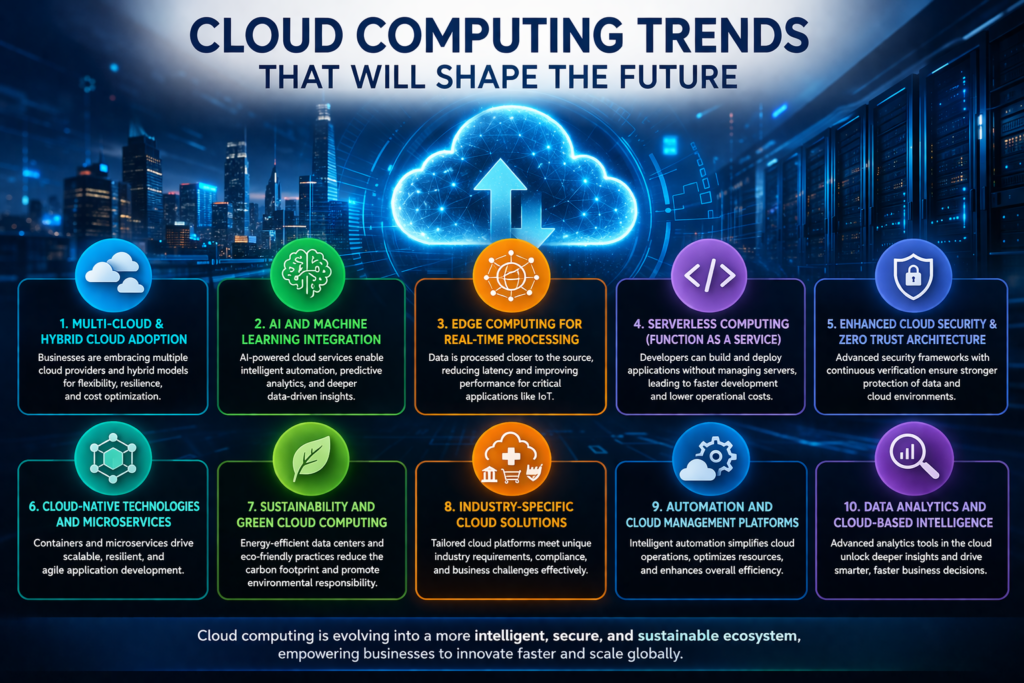
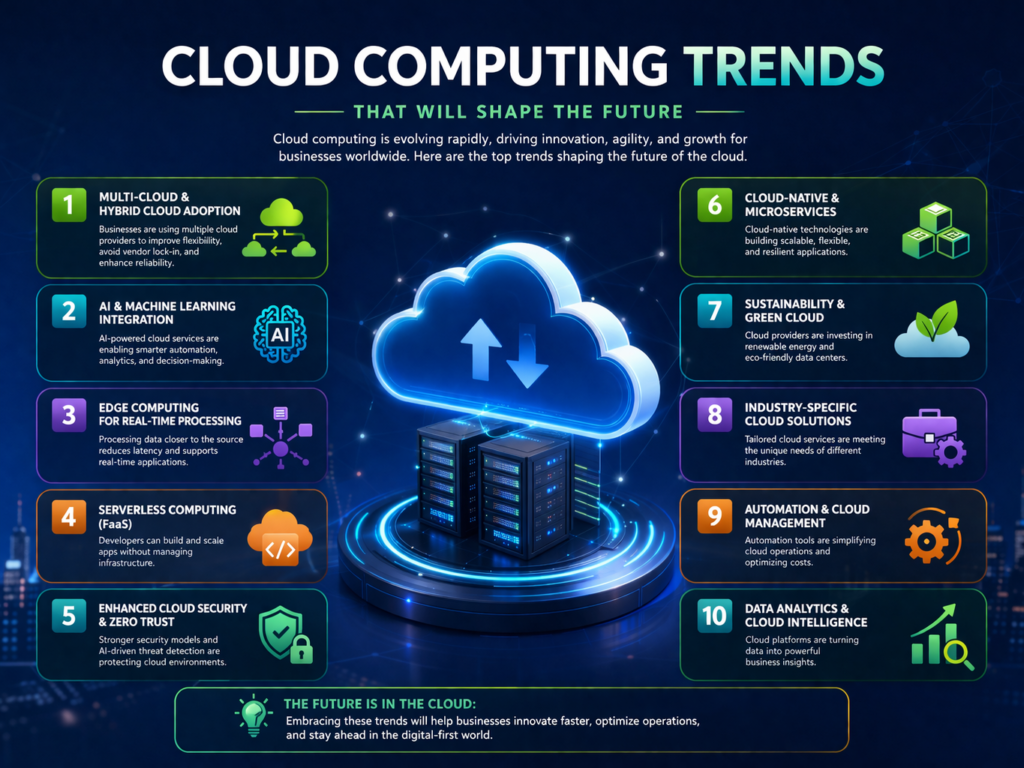
Cloud computing trends that will shape the future are transforming modern digital infrastructure, redefining how businesses store data, deploy applications, and scale operations. As organizations move deeper into a data-driven era, these cloud computing trends are evolving rapidly, enabling companies to innovate faster, improve efficiency, and stay competitive in a dynamic global market. From startups to large enterprises, cloud platforms have become essential for driving digital transformation and business growth.
The future of cloud computing is no longer limited to storage and virtualization—it now focuses on intelligence, automation, and seamless system integration. Key innovations such as multi-cloud environments, edge computing, and AI-powered cloud services are reshaping the IT landscape. In this article, we explore the most important cloud computing trends that will shape the future and how businesses can leverage them for long-term success.
1. Multi-Cloud and Hybrid Cloud Adoption
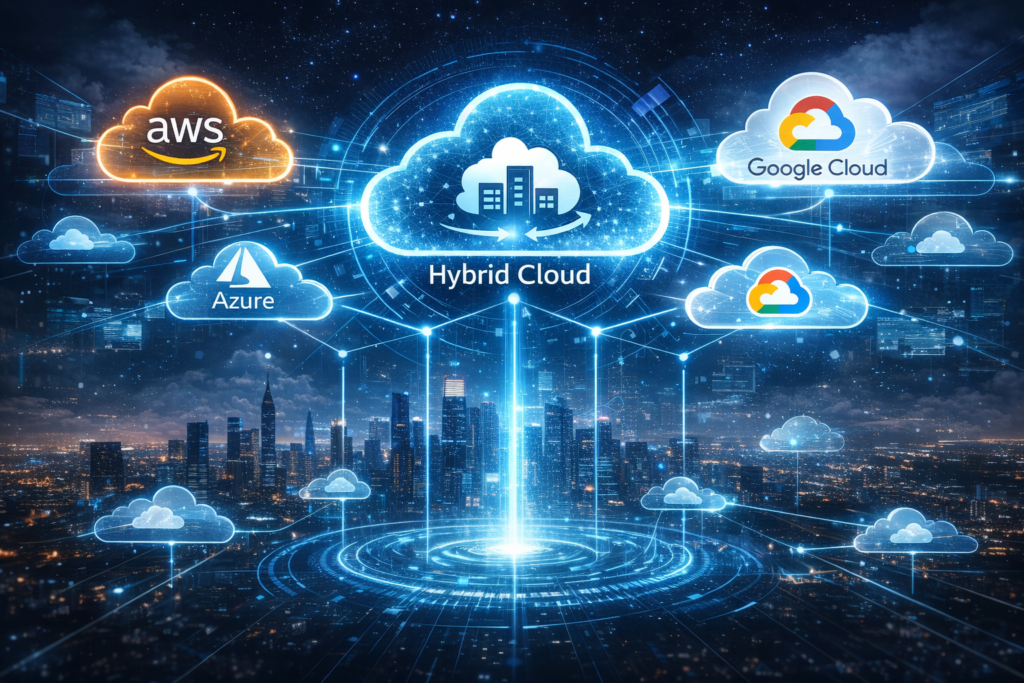
One of the most significant trends shaping the future is the widespread adoption of multi-cloud and hybrid cloud strategies. Organizations are no longer relying on a single cloud provider. Instead, they are distributing workloads across multiple platforms such as AWS, Microsoft Azure, and Google Cloud.
This approach offers greater flexibility, reduces vendor lock-in, and improves resilience. Hybrid cloud solutions, which combine on-premises infrastructure with cloud services, allow businesses to maintain control over sensitive data while benefiting from cloud scalability.
2. AI and Machine Learning Integration
Artificial Intelligence (AI) and Machine Learning (ML) are becoming integral components of cloud computing. Cloud providers are offering AI-powered tools that enable businesses to analyze data, automate processes, and gain actionable insights.
From predictive analytics to intelligent automation, AI-driven cloud services help organizations make smarter decisions. This trend is particularly beneficial for industries such as healthcare, finance, and e-commerce, where data plays a critical role.
How Cybersecurity Is Evolving in Modern Enterprises
3. Edge Computing for Real-Time Processing
As the demand for real-time data processing increases, edge computing is gaining significant traction. Unlike traditional cloud models that rely on centralized data centers, edge computing processes data closer to its source.
This reduces latency and improves performance, making it ideal for applications such as IoT devices, autonomous vehicles, and smart cities. Edge computing is expected to play a crucial role in the future of cloud infrastructure.
4. Serverless Computing (Function as a Service)
Serverless computing is revolutionizing how applications are built and deployed. With this model, developers can focus on writing code without worrying about managing servers or infrastructure.
Cloud providers automatically handle scaling, maintenance, and resource allocation. This not only reduces operational complexity but also lowers costs. Serverless architecture is becoming increasingly popular for modern application development.
5. Enhanced Cloud Security and Zero Trust Architecture
As cloud adoption grows, so do security concerns. Organizations are prioritizing advanced security measures to protect sensitive data and prevent cyber threats.
Zero Trust Architecture is emerging as a key security model, where no user or system is trusted by default. Continuous authentication and strict access controls ensure that only authorized users can access resources. Cloud providers are also integrating AI-driven security tools to detect and respond to threats in real time.
6. Cloud-Native Technologies and Microservices
Cloud-native development is transforming how applications are designed and deployed. Technologies such as containers (Docker) and orchestration tools (Kubernetes) enable businesses to build scalable and resilient applications.
Microservices architecture allows applications to be broken down into smaller, independent components. This improves flexibility, speeds up development, and enhances system reliability. Cloud-native technologies are becoming essential for modern IT environments.
7. Sustainability and Green Cloud Computing
Sustainability is becoming a priority for organizations worldwide. Cloud providers are investing in energy-efficient data centers and renewable energy sources to reduce their carbon footprint.
Green cloud computing focuses on optimizing resource usage and minimizing environmental impact. Businesses are increasingly choosing cloud providers that align with their sustainability goals, making this a key trend for the future.
Top 10 Emerging Technologies Every IT Company Must Adopt in 2026
8. Industry-Specific Cloud Solutions
Cloud computing is becoming more specialized, with providers offering industry-specific solutions tailored to sectors such as healthcare, finance, retail, and manufacturing.
These solutions are designed to meet unique regulatory requirements and business needs. For example, healthcare clouds ensure compliance with data privacy laws, while financial clouds provide enhanced security and transaction processing capabilities.
9. Automation and Cloud Management Platforms
Managing complex cloud environments can be challenging. Automation tools and cloud management platforms are helping businesses streamline operations and improve efficiency.
These tools enable automated provisioning, monitoring, and optimization of resources. AI-driven cloud management systems can predict usage patterns and optimize performance, reducing costs and improving reliability.
10. Data Analytics and Cloud-Based Intelligence
Data is at the core of digital transformation, and cloud platforms are enabling advanced data analytics capabilities. Businesses can process large volumes of data in real time and gain valuable insights.
Cloud-based analytics tools support business intelligence, customer personalization, and predictive modeling. This trend is empowering organizations to make data-driven decisions and stay ahead of the competition.
AI-Powered Analytics: Boosting Business Decisions
Conclusion
Cloud computing is continuously evolving, shaping the future of technology and business operations. Trends such as multi-cloud adoption, AI integration, edge computing, and serverless architecture are driving innovation and efficiency across industries.
Organizations that embrace these cloud computing trends will be better positioned to adapt to changing market demands, improve performance, and achieve sustainable growth. As we look ahead, cloud computing will remain a cornerstone of digital transformation, enabling businesses to unlock new opportunities and stay competitive in an increasingly connected world.
3 Responses